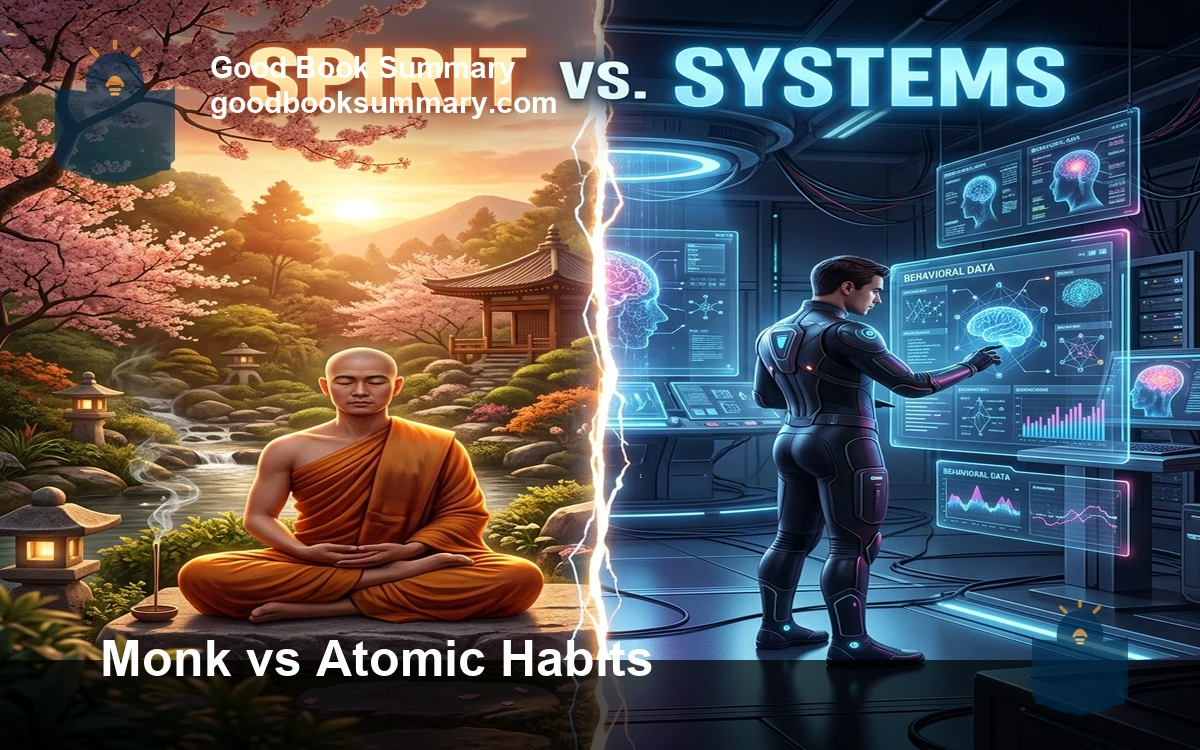
In a world overloaded with notifications, algorithms, and infinite distraction loops, two books have quietly become blueprints for modern self-mastery: The Monk Who Sold His Ferrari and Atomic Habits .
One speaks in the language of spiritual awakening and inner fire.
The other speaks in the language of systems, friction, and behavioral engineering.
But here’s the uncomfortable truth:
You don’t fail because you lack motivation. You fail because you lack either direction or structure—and often both.
The real question is not which book is better, but:
How do you combine Dharma (meaning) with systems (execution)?
🧭 Comparison Table: Spirit vs Systems
| Dimension                      | The Monk Who Sold His Ferrari                                                        | Atomic Habits                                                         |
| ------------------------------ | ------------------------------------------------------------------------------------ | --------------------------------------------------------------------- |
| Core Driver of Behavior Change | Internal spiritual awakening, discovering Dharma, cultivating the mind like a garden | External environment design, identity shift, friction reduction       |
| Method of Implementation       | 10 Ancient Rituals of Radiant Living, meditation, mantras, 21-day discipline         | Four Laws of Behavior Change, habit stacking, tracking, 2-minute rule |
| View on Setbacks               | “There are no mistakes, only lessons” — pain as spiritual growth                     | Setbacks = system failure, not personal failure                       |
⚙️ The Modern Mastery Protocol (Hybrid Model)
True transformation does not come from choosing between monkhood or systems—it comes from merging them.
1. Define Dharma and Identity
Use the “Secret of the Lake” visualization from The Monk Who Sold His Ferrari to uncover your highest self.
Then translate it into a behavioral identity:
I am the type of person who follows through, even when I don’t feel like it.
This bridges spiritual clarity with psychological identity formation from Atomic Habits .
2. Select and Simplify Rituals
Choose one ritual from the 10 Rituals of Radiant Living—for example:
- Early Awakening
- Solitude
- Physical Discipline
Then compress it using the 2-minute rule:
- Meditation → 2 minutes of stillness
- Journaling → 2 lines of reflection
Even spiritual transformation fails if it is too complex to start.
3. Automate Execution Through Systems
This is where modern behavioral science dominates.
- Use habit stacking (after X, I do Y)
- Design environment triggers (remove friction)
- Track progress visually
Now introduce discipline:
Commit to the 21-Day Rule from Sharma’s framework.
But instead of relying on willpower alone, support it with systems inspired by Atomic Habits .
🔥 Reconciling the Big Conflicts
⚖️ Goals vs Systems
- Monk view: Goals are the lighthouse—without them, you drift aimlessly.
- Atomic view: Systems are everything—goals are secondary illusions.
Reconciliation:
Goals give direction. Systems give propulsion.
Think of it like this:
- Lighthouse = Dharma (why you exist)
- Engine = Systems (how you move)
Without one, the other collapses into meaninglessness or inertia.
⚡ Willpower vs Environment Design
- Monk approach: Willpower is forged through discipline and discomfort.
- Atomic approach: Willpower is unreliable; design your environment instead.
Reconciliation:
Use willpower to build systems that eliminate the need for willpower.
Then preserve your mental energy for deeper focus states, like those described in Deep Work .
🧠 The Hidden Truth: Mastery Is Dual-Layered
Modern life breaks people not because they lack information—but because they operate with only one half of the equation.
- Spiritual seekers without systems drift.
- System builders without meaning burn out.
That is why neither book is complete alone.
We can formalize it:
Mastery = \text{Dharma (Spirit)} + \text{Systems (Habits)}One gives direction. The other gives inevitability.
🚀 The 21-Day Hybrid Mastery Challenge
If you combine both philosophies, here is the real-world application:
Days 1–7: Identity & Vision
- Define your “Dharma”
- Write identity statement
- Visualize ideal self daily
Days 8–14: System Design
- Choose 1–2 habits
- Apply 2-minute rule
- Build habit stack
Days 15–21: Execution & Reinforcement
- Track consistency
- Reduce friction further
- Reinforce identity through repetition
By Day 21, you are no longer “trying”—you are becoming.
## 🧩 Final Insight
The Monk Who Sold His Ferrari teaches you how to remember who you are.
Atomic Habits teaches you how to prove it every day.
In isolation:
- One inspires
- The other executes
Together:
- They construct a system where identity is not imagined—it is built.
And in the attention-fractured world of the digital age, that combination is no longer optional.
It is survival.
![The Monk Who Sold His Ferrari by Robin Sharma [Book Summary - Review]](/_emdash/api/media/file/01JQA7B39887BF8.webp)