15 secrets successful people know about time management by Kevin e. Kruse book summary
Kevin E. Kruse's 15 Secrets Successful People Know About Time Management presents time management as a personal operating system built around a fixed 1,440...

Kevin E. Kruse's 15 Secrets Successful People Know About Time Management presents time management as a personal operating system built around a fixed 1,440...
Mihaly Csikszentmihalyi's Creativity: Flow and the Psychology of Discovery and Invention defines creativity as a systemic process in which a person introdu...
In The Square and the Tower , Niall Ferguson argues that dynamic interactions between horizontal social networks and vertical hierarchies shape human histor...
The 5 Elements of Effective Thinking by Edward B. Burger and Michael Starbird presents effective thinking as a learnable practice built around five connecte...
Roger Lowenstein's Buffett: The Making of an American Capitalist chronicles Warren Buffett's development from a numbers-focused boy in Omaha into the chief...
Trillion Dollar Coach by Eric Schmidt, Jonathan Rosenberg, and Alan Eagle presents Bill Campbell's leadership system as an operational framework combining pe...
David Brooks's The Second Mountain presents human fulfillment as a two-mountain journey in which personal ambition and individual achievement give way, thr...
The Miracle of Mindfulness by Thich Nhat Hanh presents mindfulness as a continuous practice of present-moment awareness that links breath and body to thought...
Morten T. Hansen's Great at Work presents seven work-smart practices derived from a statistical study of 5,000 managers and employees across 15 industries ...
Nassim Nicholas Taleb's Skin in the Game argues that ethical behavior, competence, and reliable decision-making depend on symmetry between rewards and cons...
Austin Kleon's Keep Going (the practical follow-up to Steal Like an Artist and Show Your Work! ) presents creative work as a cyclical practice built aro...
Maybe You Should Talk to Someone by Lori Gottlieb is a memoir and psychotherapy narrative that examines grief, emotional defenses, relationships, mortality,...
21 Lessons for the 21st Century by Yuval Noah Harari examines how artificial intelligence, biotechnology, globalization, nationalism, religion, education, a...
The Dichotomy of Leadership by Jocko Willink and Leif Babin explains how to balance extreme ownership, decentralized command, and discipline without falling into leadership extremes.
Free to Focus by Michael Hyatt presents a productivity system built around reclaiming freedom, concentrating on high-impact work, managing renewable energy, ...
Lucius Annaeus Seneca's Letters from a Stoic presents Stoicism as a practical discipline of character in which rational judgment, disciplined desire, philo...
The Dip by Seth Godin explains strategic persistence and strategic quitting through three effort-to-result patterns: The Dip, The Cul-de-Sac, and The Cliff. ...
Thomas J. Stanley and William D. Danko's "The Millionaire Next Door" is a research-based profile of self-made American millionaires built from survey data on...
Finding Your Element by Ken Robinson defines a two part personal quest that combines natural aptitude with deliberate passion to produce sustained fulfillmen...
Small Animals: Parenting in the Age of Fear by Kim Brooks documents how American child-rearing shifted from a private relationship into a hyper-vigilant, com...
Storyworthy is a nonfiction craft book by Matthew Dicks that defines storytelling as the structured communication of personal change over time rather than th...
Insight by Tasha Eurich defines self-awareness as a learnable meta-skill built from two distinct capacities: internal self-awareness, the ability to see your...
Madness and Civilization: A History of Insanity in the Age of Reason is Michel Foucault's structural history of how European culture separated reason from un...
Farsighted: How We Make the Decisions That Matter Most is a 2018 nonfiction book by Steven Johnson. The book defines complex decision making as a three-phase...
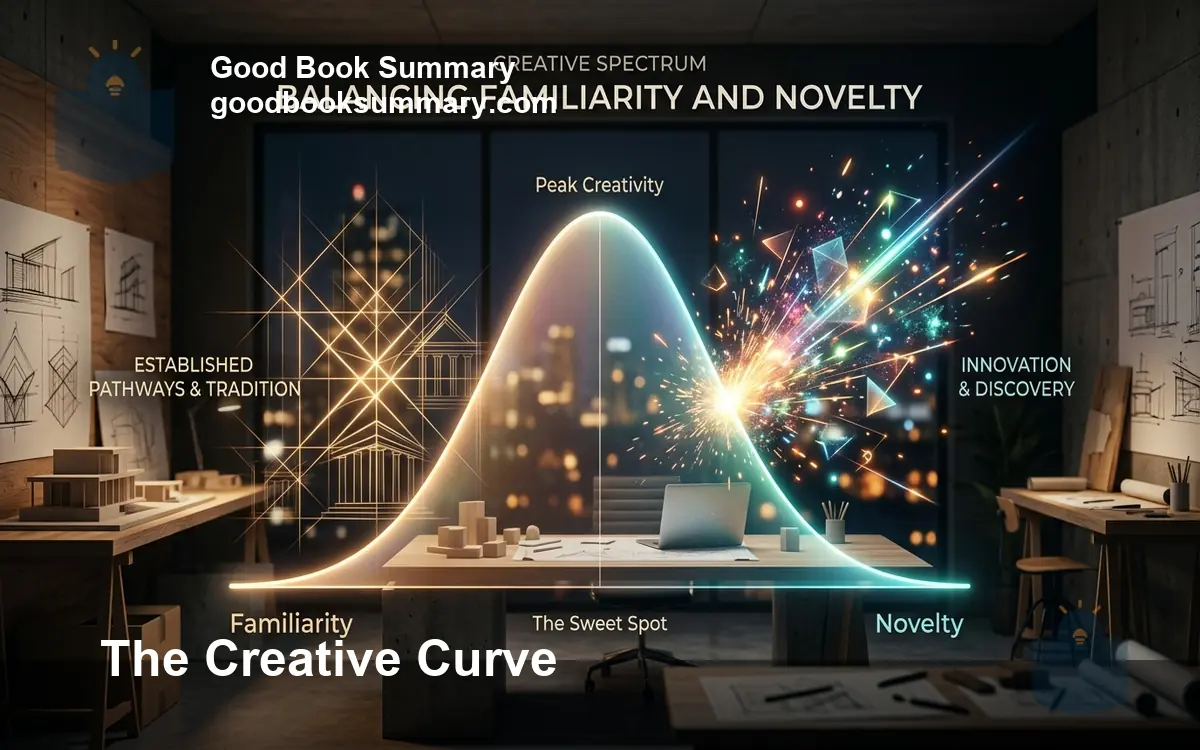
The creative curve is Allen Gannett's model for predicting mainstream creative success. In his 2018 book "The Creative Curve," he defines it as the bell-shaped relationship between how much an audience has been exposed to an idea and how much that audience prefers it.
The Execution Factor is Kim Perell's framework for closing the gap between an idea and a result, built on five interdependent traits: Vision, Passion, Action...
Every organization alive today sits in the same current. Audiences that once consumed quietly now expect to shape, remix, and own the things they care about....
Paul McGee's " How Not to Worry " defines worry as a cognitive habit, anxiety as an emotional state, and stress as a physical response, then treats the three...
Ori Brafman and Rom Brafman published Sway in 2008 to answer one question: why do capable people make decisions they would recognize as wrong in any other co...
Thirst documents Scott Harrison's move from New York City nightlife promoter to founder of charity: water, a nonprofit that funds clean water projects in dev...